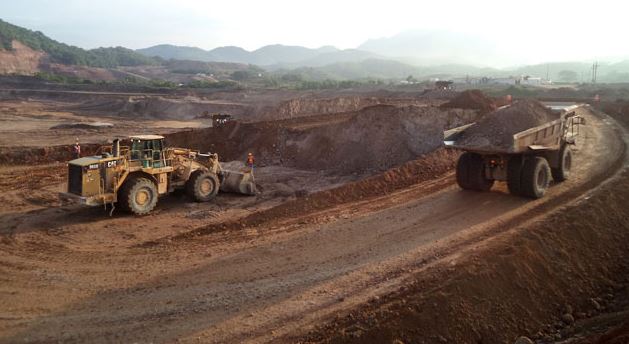
Marlin Gold Ltd is a publicly traded gold and silver mining company with properties in Sinaloa, Mexico and Arizona, USA. Marlin priority is to promote its properties in the direction of commercial production and shareholder value through the growth of its wholly owned subsidiary, Sailfish Royalty Corp. La Trinidad property in Sinaloa, Mexico, commercial production declared on November 1 increase in 2014
Mining project of Marlin
1. Mining Project La Trinidad
The wholly owned La Trinidad gold project consists of 61,612 hectares (within a larger land package of 118,518 contiguous hectares) in Sinaloa, Mexico. The project is located approximately 110 kilometers southeast of the city of Mazatlan and 42 kilometers southeast of the city of Rosario.
The most advanced target on La Trinidad is the Taunus deposit, previously of Eldorado Gold Corp ( “Eldorado”) 1996-98. After completing a preliminary economic assessment, negotiating surface rights and receiving environmental permits, Marlin has completed construction and is in the process of restarting commercial production at the Taunus deposit with a fist gold pour on February 28, 2014.
The Taunus deposit is considered a gold-rich intermediate sulfidation state ephitermal system. The mineralization occurs in strongly silicified tectonic and Quartz matrix hydrothermal breccia. Marlin acquired the Taunus deposit in 2005 and previously unknown gold mineralization identified by the deposit to a depth of approximately 200 m below the surface.
Due to the breccias nature of the rock types in the deposit area, including the mineralized material, a drilling was initiated as a sonic drilling known the end of 2010, and continued until September 2011. This drilling style was used in order to achieve maximum core recovery
2. Commonwealth Mining Project
The Commonwealth project is a development project in the historical district Pearce Mining is located in southeastern Arizona (Cochise County). Historically, the mined at the Commonwealth Mine deposits were high-grade silver and gold ores in quartz veins and stockwork zones held alongside the veins.
The Commonwealth project is a development project in the historical district Pearce Mining is located in southeastern Arizona (Cochise County). Historically, the mined at the Commonwealth Mine deposits were high-grade silver and gold ores in quartz veins and stockwork zones held alongside the veins.
Production began in 1895, with commercial scale mining of the high grade ores ending in the late 1920s. Small-scale mining from property owners during this period continued until 1942. The Commonwealth Mine produced approximately 12 million ounces of silver and 138,000 ounces of gold, to make Arizona’s second largest historic primary silver producer.
The project was extensively explored and was drilled by a number of companies from the 1970s until the mid-1990s, the access to open lower grade natural resources were open pit and heap leach extraction. Work reached the pre-feasibility study level in 1996 before being stopped due to low gold and silver prices. This work included a technical report a historical non NI 43-101 compliant mineral resource estimate, the economic analysis and pit design.
These studies included more than 15,000 meters of reverse circulation and diamond drilling, extensive metallurgical studies, geotechnical investigations and geological mapping, underground channel sampling, financial models and mining plans. No work was done until 2011 on the project from 1997, when the property was optioned by the previous owner and then exploration resumed again
The mineral deposits on the Commonwealth Project are typical silver dominant, low sulfidation epithermal veins and stockwork. The veins are best in a series of Cretaceous to Tertiary volcanic rocks of andesite composition developed correlative with the Mexican Lower Volcanic Series rhyolite. Cretaceous marine sediments of the Bisbee Group also host mineralization and are chemically favorable hosts.
The two main arteries are the main vein and the North Vein. Between these two lane, a wedge of volcanic rocks is well-developed quartz stockwork veins that is mineralized with silver and gold. The vein system has been mapped over 1 km strike length and further to the east under alluvial cover.
Drilling of this strike length to a maximum depth tested at least 800 meters of just over 200 meters. There is considerable potential extensions of the known vein system both east, west and to find the angle of inclination. All known veins in the district have a combined length of about 4.5 km away.
3. El Compas Mining Project
The El Compas property is located in the heart of the world’s most prolific silver mining area is located in Zacatecas, Mexico. El Compas is identified host to a number of gold-bearing veins on the surface. These veins were mined on the underground from a private Mexican company. Past production records are not available; However, Marlin has confirmed that high-grade gold and silver mineralization within at least two of the vein structures (El Compas vein and El Orito vein) exists. The results of the previous exploration work in a NI 43-101 resource estimate report compiled in January 30, 2011
The El Compas property is located in the heart of the world’s most prolific silver mining area is located in Zacatecas, Mexico. El Compas is identified host to a number of gold-bearing veins on the surface. These veins were mined on the underground from a private Mexican company. Past production records are not available; However, Marlin has confirmed that high-grade gold and silver mineralization within at least two of the vein structures (El Compas vein and El Orito vein) exists. The results of the previous exploration work in a NI 43-101 resource estimate report compiled in January 30, 2011
Although exploration efforts to date have focused on the gold bearing vein system at surface, Marlin believes that there is significant potential to explore for large scale silver bearing targets at depth hosted within Mesozoic rocks that are typical of the district.
4. San Albino Mining Project
The project Gold San Albino consists of 8,700 hectares (San Albino-Murra concession) within a larger contiguous land package of 13,771 hectares. San Albino is located about 173 kilometers north of Managua, the nation’s capital, and about 15 km southeast from the northern border of Nicaragua with Honduras. The deposit is hosted from a series of shallow dipping quartz sulfide veins of graphitic argillite. The San Albino resource model consists of three high-grade, vein systems – the San Albino project, Naranjo and Arras veins – over a strike length of 850 meters, a down dip extension of 925 meters, with a minimum true width of one meter and average true width of 2, 6 m.
The project Gold San Albino consists of 8,700 hectares (San Albino-Murra concession) within a larger contiguous land package of 13,771 hectares. San Albino is located about 173 kilometers north of Managua, the nation’s capital, and about 15 km southeast from the northern border of Nicaragua with Honduras. The deposit is hosted from a series of shallow dipping quartz sulfide veins of graphitic argillite. The San Albino resource model consists of three high-grade, vein systems – the San Albino project, Naranjo and Arras veins – over a strike length of 850 meters, a down dip extension of 925 meters, with a minimum true width of one meter and average true width of 2, 6 m.


 /*
/*